
Big Gay Book Review – Magic’s Pawn by Mercedes Lackey
Written by Jay Bell on February 11, 2010 – 5:19 pm -
I’ll never forget the thrill I had when reading Mercedes Lackey’s first book in the Last Herald Mage trilogy entitled “Magic’s Pawn.” A friend loaned me a copy, saying very little about it other than I might enjoy it. The story starts with Vanyel, son to an uncaring father and heir to his lands, struggling with his home life. We aren’t talking whiney rich kid here. Vanyel’s trouble are serious, both physical and emotional in nature, and it comes as a great relief to the reader when he is sent away to live with his Aunt in the capital city of Haven.
Often times while reading I pretend characters are gay until the plot forces me to think otherwise, and I did the same with Vanyel. Imagine my delight when he actually turned out to be gay. Vanyel doesn’t discover this until his exodus to Haven, an act intended as punishment, but one that becomes a blessing when Vanyel meets the love of his life, Tylendel. A decent chunk of the novel is taken up by this relationship, but happy endings don’t belong at the beginning of a story, so a parade of surprising conflicts soon interrupt their happy honeymoon. Where Lackey takes their relationship over the trilogy of books, is something better left experienced than described.
Lackey’s portrayal of a gay relationship is a bit hit and miss, occasionally coming across as too flowery and feminine. I suspect that’s partially due to the aristocratic backgrounds given to the characters along with the author obviously not being a gay man. Considering how few homosexual characters were present in popular media back in 1989, I think Lackey did a commendable job regardless.
One thing I certainly appreciate is that the story and characters aren’t preoccupied by coming out. Acceptance of their sexuality comes nice and quick, both internally and from the society surrounding them. Too often coming out dominates the entirety of a plot, but with this out of the way, Vanyel and Tylendel are able to get on with their relationship without having to tackle this age old issue.
On rereading “Magic’s Pawn,” I was surprised to discover echoes of Harry Potter in this tale, since Vanyel is a sympathetic character, misunderstood, unappreciated, and abused by his family until the day he is sent off to a more colorful and magical world. It’s a very effective way of getting the reader on the protagonist’s side. Who knows, maybe Rowling drew inspiration from this earlier tale when writing her own books.
It had been a long time since I read this trilogy, and naturally I thought of it when writing my own gay fantasy novel, but this made me avoid it like the plague. Lackey did it right, and long before anyone else had done it, and I didn’t want to step on her toes. Her success and bravery in incorporating gay characters long before the world had warmed to the idea was a constant inspiration to go ahead with my own vision, and for that I am eternally grateful to her. To me, the Last Herald Mage trilogy will always be the first and most classic gay fantasy series, and I can only hope there are many more to come.
Related posts:
Posted in Books, Fantasy, Gay | Add Comment »
Fantasy’s Finest: Piers Anthony’s Apprentice Adept Series
Written by Jay Bell on February 1, 2010 – 2:07 pm -
There aren’t many series that I can read and reread without ever tiring of, but Piers Anthony’s Apprentice Adept series is one of them. Seven glorius books tell the story of Proton, a technologically advanced planet, and its twin Phaze, a world of traditional fantasy. Both Proton and Phaze occupy the same space, being separated only by a dimensional veil that few have learned to cross. In effect, we have a world that is both science fiction and fantasy, a literary playground with high potential, but this isn’t what enamored me with the series.
The society of Proton functions as a sort of Feudalistic lottery. Those arriving on the planet are serfs and must be employed by Citizens; a select group of wealthy and powerful individuals. After playing servant for twenty years, they must leave the planet, but the wages earned are enough to set them up for life. If a serf plays and win The Game, which encompasses all sports, board games, or any otherconceivable challenge, they can win the right to stay on Proton and become a Citizen themselves.

The dimension of Phaze is mostly unknown to the people of Proton, because each has a doppelganger on the other side. Only those that do not can travel between the two dimensions. Phaze is everything there is to love about fantasy. Werewolves run along side unicorns, vampires and trolls lurk in the shadows, and the very best of all is the Adepts. Counterparts to the Citizens of Proton, the Adepts are equally influential, but their power comes from magic rather than wealth.
This is what I love most about the series. Each Adept is known by a different color, and each has a different way of executing their magic. For instance, the Yellow Adept deals in potions. The icy White Adept uses runes to work her magic, and the Blue Adept must play music to summon his power. I adored this concept, and loved discovering the strange and wonderful personalities that Anthony gave to each of these strange characters. The plots of these books are wonderful, full of adventure and intrigue, but the strange world of the Adepts is what has always held my rapt attention.
So enamored was I by this concept, that I borrowed heavily from it for my own book, The Cat in the Cradle. My story is strictly fantasy, but it’s no coincidence that the ten powerful Oligarchs that rule the Five Lands are each designated by a different color and magical ability. I’m very proud to be inspired by Piers Anthony, and was thrilled when he agreed to read my book. I feel a bit embarrassed now, since The Cat in the Cradle wasn’t professionally edited at the time, but the feedback and comments he gave me were very encouraging and kind. Most of all, it just felt good to hand him something that proved what a massive influince his books have had on me.

I’ve barely touched on the characters that fill the Apprentice Adept series, but they are as varied as a multi-genre novel should be. Robots, harpies, androids, shape shifting amoebas, ice demons, bug eyed aliens, and humans all have their role to play, and as hard is it might be to imagine all these elements working together, Anthony pulls it off with style. Piers is best known for his Xanth series, but anyone that hasn’t discovered the Apprentice Adept books is missing out on a truly enjoyable world. To me, this series will always be the very best of Piers Anthony’s creations, and the one closest to my heart.
Books in the series:
1. Split Infinity (1980) ISBN 978-0345354914
2. Blue Adept (1981) ISBN 978-0345352453
3. Juxtaposition (1982) ISBN 978-0345349347
4. Out of Phaze (1987) ISBN 978-0441644650
5. Robot Adept (1988) ISBN 978-0441731183
6. Unicorn Point (1989) ISBN 978-0441845637
7. Phaze Doubt (1990) ISBN 978-0441662630
Related posts:
Posted in Books, Fantasy | 5 Comments »
Fantasy’s Finest: He-Man and the Masters of the Universe
Written by Jay Bell on August 21, 2009 – 4:08 pm -
The inclusion of “He-Man and the Masters of the Universe” as being among fantasy’s finest might raise some eyebrows, but behind the cheesy 80’s cartoon lies a truly inspired concept. When first considering the world of He-Man, we immediately think of a standard fantasy world involving sword and sorcery, forgetting sometimes that MOTU was just as much sci-fi as it was fantasy. Vehicles flew alongside dragons, blasts from laser pistols were deflected by magic swords, and the evil wizard Skeletor used often employed hovering robots as his muscle. Surprisingly this mishmash of magic and science worked very well. The series always weighed heavily in favor of fantasy, but embracing technology into the mythos made room any story the writers could dream up.
Central to the story is lazy Prince Adam who, with the aid of his magic sword, can become the heroic He-Man. It’s Clark Kent/Superman meets Conan really, although the idea is improved upon by Adam bring vulnerable when not powered up as his alter ego. This much needed weakness adds tension and allows for a sense of danger. He-Man’s closest friend and sidekick is Cringer, a giant talking cat. This is a concept very close to my heart. The two main characters of my book, The Cat in the Cradle, just happen to be a boy and his talking cat. The similarities end there, but I’ve always been aware that I was drawing inspiration from my favorite childhood show.

Masters of the Universe was fairly progressive with its portrayal of strong, female characters. Teela was captain of the royal guard and could hold her own in battle. On the villain’s side, second in command went to witchy Evil-Lyn, one of the only competent members. Likewise, the Sorceress was used in place of the wise old wizard archetype, and was keeper of the most powerful magical secrets. Minorities weren’t as well represented in the cartoon, probably because not many characters were actually human. A scaly merman, a flying bird guy, a humanoid skunk, a robot with a heart, a blue guy with mechanical arms, even a man made of moss. Almost every character was a different type of species or creature, mostly due to the toy line that powered the cartoon. Commercialism aside, the variety of action figures made for a diverse and interesting cast.

The 80s version of the cartoon leaves a lot to be desired. Its frequent reuse of stock animation, public service announcements, and plots aimed low at child audiences of days gone by makes it hard to digest today. Luckily there was a new version of the show in 2004 that fully realized the story’s potential. The somewhat jumbled nature of the 80s concept was reined in and given order, the plots were intelligent with long reaching story arcs, and the action sequences had you on the edge of your seat. Sadly the toy line, the lifeblood of any cartoon, was mismanaged and ended the show prematurely. The two seasons that did air stand as a proud testament to just how excellent and exciting the world of Masters of the Universe can be.
Related posts:
Posted in Fantasy, Television | Add Comment »
Fantasy’s Finest: Avatar the Last Airbender
Written by Jay Bell on July 10, 2009 – 8:00 am -![]()
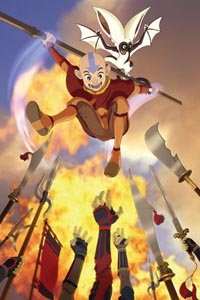
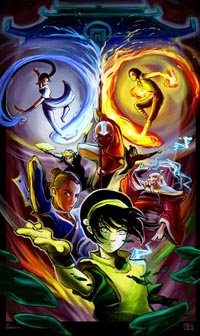
Children’s cartoons are often overlooked by the adult populace. It’s a shame because fiction geared toward kids is often more daring and innovative, unhindered by concerns of what the audience might accept. Avatar: the Last Airbender is a wonderful example of this, a show that manages to be adventurous and fun while still being earnest and emotional. The world of Avatar is made up of four nations; The Earth Kingdom, The Fire Nation, The Air Nomads, and The Water Tribe. Select members of each nation can magically manipulate the element of their people, an art known as bending.
The Avatar is the only person capable of bending all four elements, and acts as a sort of ambassador/policeman to the four nations, keeping them all in check and ensuring peace. The Avatar always exists, reincarnating upon his (sometimes her) death. Unexpectedly, the Avatar goes missing. In his absence the Fire Nation decimates the people of Air and Water, and the Earth Kingdom seals itself off from the rest of the world. After many years Katara of the Water Tribe and her brother Sokka find the Avatar, reincarnated as a young boy named Aang. Together they must help him master all four elements so he may defeat the Fire Lord and bring peace to the world again.
Basic premise out of the way, each episode is its own individual adventure while adding to the overall story arc. It’s a smart show too. Events aren’t forgotten just
because they aired last week. The show references itself often, minor characters resurfacing from time to time. As for the main characters, they grow on you and soon
feel like friends of your own. The writing for the show is phenomenal, entertaining while tackling serious global issues. The backdrop of war torn nations was very poignant during the years the show first aired. The show is also heavily influenced by Eastern styles and philosophies.
When my book The Cat in the Cradle comes out, many readers may think it was directly inspired by Avatar. Characters in my story can manipulate the elements (ten instead of four) and some of the same issues, such as the morality of killing your enemy, are explored. I can safely say that my manuscript was already completed before I discovered this show, but I saw in Avatar a kindred spirit to my own story. Much more than just a kids cartoon, Avatar made me laugh, cry, and keep tuning in until the last brilliant episode. The show came to a graceful end after three seasons and didn’t try to artificially extend itself despite its popularity. All three seasons are now available on DVD for newcomers to enjoy or for old fans to rediscover.
Related posts:
Posted in Fantasy, Television | 10 Comments »
Fantasy’s Finest: Robert Asprin’s Myth Adventures
Written by Jay Bell on July 6, 2009 – 10:26 am -
This is the first in a series of posts that celebrate my favorite fantasy, whether it be books, movies, comics, or cartoons. I’m starting out with one of my favorite series. Packed with humor and overflowing with creativity, Robert Asprin’s Myth series has always been the sincerest of pleasures to read.
The first book, Another Fine Myth, begins with apprentice magician Skeeve struggling to perform even the most simple of magic. It’s no wonder considering that Skeeve would rather be a thief. His master decides to summon a demon to scare some respect into him, but during the ritual is attacked by an assassin. Master and assassin manage to kill each other, leaving Skeeve alone with the summoned demon.
Aahz, as we learn the demon is called, is simply a magician from another dimension. Having lost his own magical skills, Aahz takes Skeeve under his wing, teaching him magic and more often the fine art of the con. Over the course of the series they visit different worlds, hopping from dimension to dimension and getting into trouble while trying to make a profit at the same time.

The stories are humorous while maintaining the seriousness of the conflicts they face. It’s not an easy combination to pull off, but Asprin manages wonderfully. The first six book in the series are brilliant. It’s with the 7th book, M.Y.T.H Inc. Link, that the series begins to suffer. The point of view is given to minor characters instead of Skeeve, and the personalities of the major players become unrecognizable. The late Robert Asprin led a troubled life, suffering from long bouts of writer’s block and battles with the IRS. He even gave up writing to be a street musician in New Orleans at one point.
Perhaps because of this the Myth books only get progressively worse as they go along, but those early novels remain timeless masterpieces. Five years before Pratchett would pen his first Discworld novel, Asprin was already bringing humor to the world of fantasy. His novels are slim and yet carry more creativity than books three times their size. Give them a try. You won’t be disappointed.
Recommended reading:
Another Fine Myth (1978) ISBN 0-441-02359-2
Myth Conceptions (1980) ISBN 0-441-55519-5
Myth Directions (1982) ISBN 0-441-55525-X
Hit or Myth (1983) ISBN 0-441-33850-X
Myth-ing Persons (1984) ISBN 0-441-55276-5
Little Myth Marker (1985) ISBN 0-441-48499-9
Related posts:
Posted in Books, Fantasy | 3 Comments »
The Illustration Process
Written by Jay Bell on July 3, 2009 – 9:12 pm -I remember in my younger days how, when reading fantasy novels, I would often turn a critical eye to the cover. Inevitably there would be a couple details that didn’t perfectly match the author’s description. Often it was an incorrect hair style, the wrong weapon, or a falsely colored dragon. I often wondered how this could happen. Didn’t the artist read the book? Didn’t the author have a say? Wouldn’t they demand a correction before publication or did they not care?
In addition to the cover art, my husband Andreas has kindly volunteered to draw 25 illustrations for The Cat in the Cradle, one for each chapter. He’s already familiar with my book so we sat down to work out some rough sketches together. I even took a red pen to these early drafts, keen to prevent the errors I was used to spotting.

The results were unexpected. Andreas keeps coming up with images much more creative than my imagination. He brings vivid life and detail to my fictional locations, much more than I originally visualized. I didn’t get exactly what I was imagining. I got something much better. It’s great! I’ve even done rewrites to incorporate some of his ideas. Below you can see a time-lapse video of Andreas drawing one of the chapter illustrations, sandwiched in between me acting all dorky over how much I love him.
Interestingly enough, there is one drawing that conflicts with what my book describes. I like what he did too much to ask him to change it and I can’t find a way to write around it. In the end I decided to keep it in there as a loving tribute to a long standing tradition.
You can see more of Andreas’ work at his web site:
http://www.andreasbell.com/
Related posts:
Posted in Books, Fantasy, The Cat in the Cradle | 1 Comment »